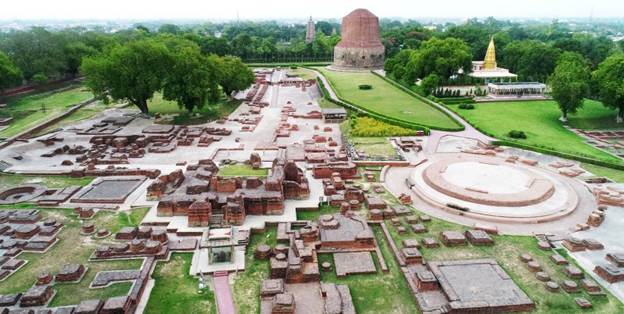
Ancient Buddhist Site of Sarnath Inscribed on UNESCO World Heritage List
Sarnath is revered as the place where Gautama Buddha delivered his first sermon, known as the Dharmachakra Pravartana, or the turning of the wheel of Dharma, after attaining enlightenment at Bodh Gaya. The historic event marked the beginning of Buddha’s teaching journey and the establishment of the Buddhist Sangha. Over centuries, Sarnath developed into an important centre of Buddhist learning and pilgrimage, attracting followers and scholars from different parts of the world.
The site is renowned for its archaeological remains, ancient monasteries, stupas, temples and other structures that reflect the evolution and spread of Buddhism in the Indian subcontinent. Among its most celebrated monuments is the Dhamek Stupa, a massive structure traditionally associated with the location of Buddha’s first sermon. The Ashoka Pillar, erected during the reign of Emperor Ashoka, is another important historical feature of Sarnath. The Lion Capital of Ashoka, originally installed at Sarnath, has become the National Emblem of India and is a powerful symbol of the country’s historical and cultural identity.
The UNESCO World Heritage inscription is expected to further strengthen international awareness of Sarnath’s outstanding universal value and encourage greater efforts towards the conservation, protection and sustainable management of the heritage site. It also highlights the enduring influence of Buddhist philosophy and India’s contribution to the development and dissemination of Buddhist thought across Asia and beyond.
The recognition is a significant achievement for India’s heritage conservation efforts and is expected to promote Sarnath as an important destination for cultural tourism, pilgrimage and academic research. It will also provide an opportunity to showcase the country’s ancient civilisational heritage to a global audience while reinforcing the importance of safeguarding historic monuments and archaeological sites for future generations.
The inscription of Sarnath on the UNESCO World Heritage List adds another distinguished chapter to India’s long-standing cultural and spiritual heritage. It celebrates the site’s universal significance and its continuing role as a symbol of peace, knowledge, compassion and the timeless teachings of Buddhism.