‘We Had Almost Lost Hope’: 84-Year-Old Woman Walks Again After Highly Complex Heart Surgery at CARE Hospitals, Hitech City
· Family approached CARE Hospitals after surgery was reportedly deferred elsewhere due to extremely high surgical risk
· Elderly patient with severe kidney disease and pulmonary hypertension recovered within days after minimally invasive heart surgery
· Doctors say advanced minimally invasive procedures are transforming treatment options for high-risk elderly cardiac patients
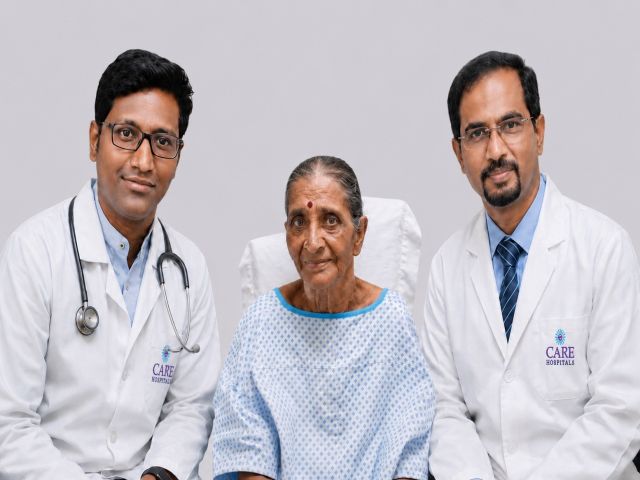
In a remarkable high-risk cardiac success, doctors at CARE Hospitals, Hitech City, successfully performed a complex Minimally Invasive Cardiac Surgery (MICS) Mitral Valve Replacement on an 84-year-old frail woman from Anantapur suffering from severe heart failure, advanced kidney disease, and severe pulmonary hypertension.
Mrs. SubhaRathnamma was admitted in a critical condition with recurrent hospital admissions for congestive heart failure and severe breathlessness. She had become extremely weak, almost bedridden, and required oxygen support even while resting.
Detailed evaluation revealed severe mitral valve prolapse with advanced pulmonary arterial hypertension. Doctors also found that she was suffering from advanced chronic kidney disease with a severely compromised kidney function (eGFR of only 15 ml/min), making the case extremely high-risk for conventional open-heart surgery.
According to family members, they had consulted multiple hospitals earlier, but surgery was reportedly deferred due to her advanced age, frailty, kidney dysfunction, and multiple comorbidities. With her condition worsening progressively and quality of life deteriorating significantly, the family approached CARE Hospitals, Hitech City, as a final hope.
After comprehensive multidisciplinary evaluation and meticulous perioperative planning, the highly specialized heart team, involving cardiac surgeons, interventional cardiologists, cardiac anesthesia specialists, intensivists, and nephrology experts, decided to proceed with Minimally Invasive Cardiac Surgery (MICS) Mitral Valve Replacement using a tissue valve.
The surgery was performed successfully despite the extremely high surgical risk. The patient was extubated on the first postoperative day, required only minimal supportive medications, and remained hemodynamically stable during recovery.
Within a few days, the elderly patient, who once struggled to breathe even at rest, showed remarkable improvement. She gradually regained strength, started walking independently, was able to sleep comfortably again, and no longer required oxygen support. Family members said the biggest emotional moment came when the 84-year-old patient was finally able to walk comfortably and breathe without oxygen support after months of suffering.
Dr. Ravi Raju Chigullapally, Sr. Consultant Cardio Thoracic Vascular, Minimally Invasive & Endoscopic Cardiac Surgeon, CARE Hospitals, Hitech City, said, “Performing cardiac surgery in an 84-year-old frail patient with severe pulmonary hypertension, advanced kidney disease, and multiple comorbidities is extremely challenging. In many such cases, patients are considered inoperable because the risks are very high. However, minimally invasive cardiac surgery helps reduce surgical trauma, blood loss, postoperative pain, and recovery time. Careful planning, precise execution, and coordinated multidisciplinary care played a crucial role in achieving this successful outcome.”
Dr. V. Vinoth Kumar, Cathlab Director & Sr. Interventional Cardiologist, CARE Hospitals, Hitech City, said, “Many elderly patients continue suffering with severe valvular heart disease because they assume treatment may not be possible due to age or associated illnesses. Advancements in minimally invasive cardiac procedures are now helping even high-risk elderly patients undergo treatment safely and regain a significantly better quality of life. Timely intervention can help prevent repeated heart failure admissions and serious complications.”
Doctors explained that advanced mitral valve disease in elderly frail patients often goes untreated because conventional open-heart surgery can carry significant risks, particularly in patients with kidney failure, pulmonary hypertension, and severe frailty. However, minimally invasive cardiac surgery is increasingly emerging as an important treatment option for carefully selected high-risk elderly patients, offering smaller incisions, lower surgical trauma, faster recovery, and improved postoperative outcomes.
The team emphasized that timely evaluation and advanced cardiac intervention can significantly improve survival and quality of life even in highly complex elderly patients who may otherwise be left with very limited treatment options.